
The State of Branding in Thailand: 2026 Report

Executive Summary
Branding in Thailand is being reshaped by three pressures at once: consumers who trust selectively, AI-driven search that describes brands using other people's words, and a gap between what brands promise and what customers experience. This report synthesizes publicly available research and observable market practice into six trends for 2026. Brand trust is built increasingly through consistent delivery, not consistent visuals alone. Brand voice now has to work where a brand does not control the page, including AI answers, reviews, forums, and video. Rebranding is shifting from dramatic resets toward careful evolution that protects familiarity. Purpose and employer brand are judged by proof rather than slogans. Community-led brands and earned voices carry more weight than brand-owned messaging. And brand measurement and governance are becoming operating disciplines rather than occasional projects. Together, the trends describe a market where the brands that gain ground are clear about who they are, consistent in how they show up, and credible to people who are not paid to say so.
Key Findings at a Glance
Trust is local and selective. Edelman's 2026 Trust Barometer reports that Thai respondents trust Thailand-headquartered companies 14 points more than foreign-headquartered ones.
The promise gap is a brand problem. In Ipsos research, 55% of Thais said their experiences are generally worse than companies promised, and 42% would buy less or stop buying.
Word of mouth outweighs brand messaging. Ipsos reports that 86% of Thais were influenced by recommendations from friends, family, and acquaintances, against a 56% global average.
AI answers lean on third-party sources. A Thailand-focused study by the agency Primal reports that only 4% of AI citations about brands came from the brand's own website.
Mentions travel further than backlinks. Ahrefs reports a 0.664 correlation between branded web mentions and AI Overview brand visibility, against 0.218 for backlinks, across 75,000 brands globally.
Purpose is judged by proof. Edelman reports 78% trust in "my employer" among employees, while a Thai job-seeker survey by Adecco found that skills fit and pay matter more than company reputation when people apply.
Governance is lagging AI-speed content. A US survey by IAB found that over 70% of marketers had experienced an AI-related incident such as off-brand content.
Why This Report Matters Now
For many Thai businesses, "branding" still means a logo, a color palette, and a launch campaign. That view was always incomplete, and it is now expensive. A brand is assembled from thousands of small signals: how a customer service message is worded, what a delivery rider says, how a reviewer describes a product on a public forum, what an AI assistant says when someone asks which company to trust. Most of those signals sit outside the marketing department's direct control.
Three shifts make 2026 a useful moment to step back. Trust has become more selective, with Edelman describing an "insular" mindset in which people favor what feels familiar. Discovery has moved partly into AI-generated answers, where a brand may be summarized without a click reaching its website. And content production has accelerated through generative tools, which makes consistency easier to lose and harder to notice. Treating these as facets of one question, what is this brand known for and does everything support it, is more useful than treating them as separate problems. This report is an orientation document, meant to sit alongside practical guides on guidelines, rebranding, and brand strategy.
Key Data Points
The figures below come from published third-party research, not Clout Media's own measurements. Several are global or regional rather than Thailand-specific and are labeled as such. Figures from a single agency or a limited sample should be read as directional.
Domestic trust advantage in Thailand (2026): Reportedly 14 points: Thai respondents trust Thailand-headquartered companies more than foreign-headquartered companies — Edelman Trust Barometer 2026 (APAC findings), as reported by LBBOnline
Thai consumers: promises, word of mouth, Gen Z (2025): Reportedly 55% say experiences are generally worse than companies promised; 42% would buy less or stop buying; 86% are influenced by recommendations from friends, family, and acquaintances (global average 56%); 63% of Thai Gen Z trust influencer recommendations more than direct brand messaging — Ipsos, "CX Global Insights 2025: Unveiling Thailand's CX Landscape"
What makes a brand relevant (global, 2026): Reportedly utility 85%, identity reflection 81%, community connection 77%, emotional resonance 76%, pop-culture fluency 67%; nearly 9 in 10 consumers say trust is a critical purchasing factor — Edelman 2026 Special Report "Brand Growth in an Insular World", as reported by Adgully
Where AI gets its information about Thai brands (2026): Reportedly only 4% of AI citations about a brand came from its own website; the top 2 brands per category held about 76% of AI mentions on average (128 Thai brands, 5 industries, 90 days) — Primal, "How Thai Brands Win AI Search in 2026"
Brand mentions and AI visibility (global, 2025): Branded web mentions show a 0.664 correlation with AI Overview brand visibility, against 0.218 for backlinks (75,000 brands) — Ahrefs, "An Analysis of AI Overview Brand Visibility Factors"
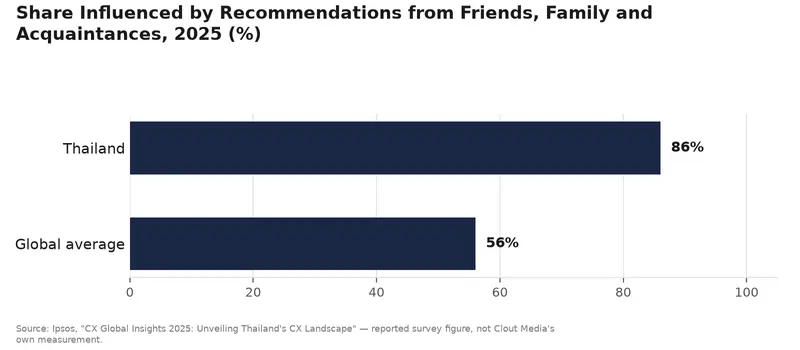
Share Influenced by Recommendations from Friends, Family and Acquaintances, 2025 (%)
Thailand: 86
Global average: 56
Source: Ipsos, "CX Global Insights 2025: Unveiling Thailand's CX Landscape" — reported survey figure, not Clout Media's own measurement.
Trend 1: Consistency Becomes the Trust Mechanism
Brand consistency usually means visual consistency: the same logo, colors, and typeface. Those matter because they make a brand recognizable. But the more important consistency in 2026 is the match between what a brand says and what a customer experiences. Ipsos's 2025 research puts a number on the gap: 55% of Thais said their experiences are generally worse than companies promised, and 42% said they would buy less or stop buying when experiences fall short. The same research reports that 73% of Thais choose a brand because they know the experience will be good. Trust is largely a memory of promises kept.
That is why strong brand-building advice increasingly sounds like operations advice. A promise of care, speed, or premium quality is only as credible as the weakest touchpoint that has to deliver it: the LINE chat reply, the packaging, the after-sales process, the way a branch team handles a complaint. Kantar's 2026 BrandZ study of Southeast Asian brands, which includes Thailand, notes that the strongest brands invest consistently in brand building and build what Kantar calls Meaningful Difference, meaning they meet consumer needs while standing apart from competitors.
Trust in Thailand also has a local dimension. Edelman reports a 14-point advantage for domestic companies in Thailand, part of a regional preference for the familiar. That is an opportunity, not an entitlement: familiarity helps only when the brand is also clear and dependable, and foreign brands must show local relevance through behavior and language. On the visual side, a brand identity is best understood as a system for being recognized quickly and remembered correctly, which differs from a set of attractive graphics. Clout Media's guide to brand design versus graphic design explains the distinction.
Trend 2: Brand Voice Must Work Where the Brand Doesn't Control the Page
For years, brand voice meant how a company wrote its own website, ads, and social posts. AI-generated answers change the problem. When a customer asks an assistant which clinic, bank, hotel, or furniture store to consider, the answer is assembled from many sources, and the brand's own site is often a minor contributor.
A Thailand-focused study by the agency Primal, covering 128 Thai brand projects in five industries over 90 days in 2026, reports that only 4% of what AI cited about a brand came from the brand's own website. The rest came from sources the brand does not own, with YouTube, Facebook, and Thai sites such as Pantip, Kapook, and Wongnai among the most cited. The same study reports that the top two brands in each category captured about 76% of AI mentions on average. This is one agency's dataset, limited to five industries, so it should be read as directional. It is consistent with global analysis from Ahrefs: across 75,000 brands, branded web mentions showed a 0.664 correlation with visibility in Google's AI Overviews, compared with 0.218 for backlinks. Correlation is not causation, but the pattern is consistent: being talked about, clearly and repeatedly, appears to matter more than merely publishing.
For brand voice, this has three consequences. Voice is no longer only what a brand writes; it is also the pattern of how others describe it, and if reviewers, creators, and journalists each use different words for what the brand does, AI summaries will reflect that blur. A distinct, repeatable description of the brand's category, audience, and difference, used consistently in owned and earned content, gives outsiders language to borrow. And a voice is only useful if it is tied to a real position, whereas generic AI-written copy tends to sound like everyone else. Clout Media's article on whether ChatGPT can write a brand strategy explores where generative tools help; for the search side, see what AIO means for Thai brands.
Trend 3: Rebranding Shifts From Reset to Evolution
Rebranding used to be treated as a moment of reinvention: a new name, a new logo, a big reveal. Where familiarity carries trust, and where a brand's reputation lives in reviews, search results, and AI summaries as well as on its signage, dramatic resets carry more risk. Market practice increasingly favors evolution: keep what customers already recognize, fix what no longer works, and change the message only where the business itself has changed.
Triggers for a rebrand remain practical rather than fashionable: a merger or change of ownership, an expansion into new segments or markets, an identity that no longer matches the company's current quality level, or a visual system that does not work on modern screens. In each case the useful question is not "how different can we look?" but "which existing associations are worth protecting?" Kantar's BrandZ research points in a compatible direction, linking growth to Meaningful Difference built over time. This report does not cite a quantitative study on rebranding outcomes, so this point is qualitative synthesis of how practitioners approach the decision.
A rebrand also has a digital afterlife that is easy to overlook. Old names and descriptions remain in directories, review platforms, articles, and AI-generated summaries for a long time, so a business that changes its name without updating them may find customers and machines still describing the old brand. Planning the transition, including how existing customers will recognize the business and how third-party descriptions will be updated, matters as much as designing the new identity. For a step-by-step view, see Clout Media's guide to rebranding without losing customers.
Trend 4: Purpose and Employer Brand Are Judged by Proof
Brand purpose has been debated for years, and the debate has produced a more skeptical audience. Edelman's 2026 findings suggest values still matter: 42% of respondents globally are unwilling to invest in companies that do not share their values, and 42% of employees would rather switch departments than report to a manager with different values. But the research also points to where credibility comes from. Edelman reports that "my employer" is the most trusted institution, with 78% trust among employees, 14 points ahead of business in general (64% among the general population). People trust what they can observe up close, which makes a company's employees some of its most credible brand voices.
Thai job-seeker research adds realism. In a survey of more than 1,400 participants at Job Expo 2025, Adecco Thailand found that job stability and a good salary were top priorities, and that most respondents apply when a job matches their skills (48%) or offers attractive salary and benefits (39%). Company reputation and referrals had significantly less impact on application decisions. The sample came from a single job fair and is not representative of all Thai workers, but it suggests employer branding works best when it communicates concrete things, such as career paths, benefits, stability, and team culture, rather than lofty statements alone.
For brand purpose more broadly, the lesson is to make fewer claims and back each with something observable. A claim to be sustainable, local, or family-run will be tested by reviewers and search. Purpose as a slogan is easy to write; purpose as a practice becomes part of how others describe the brand, including AI.
Trend 5: Community-Led Brands and Earned Voices
Recent research consistently suggests people believe other people more than they believe brands. In Edelman's 2026 special report on brand growth, as reported by Adgully, more than four in 10 respondents said that what unpaid voices say about a brand has the greatest impact on trust, compared with 20% who cited a brand's own communications. Edelman also reports that 54% feel a sense of connection with others who use the same brands, up eight percentage points from five years ago, and that 77% cite community connection as a driver of relevance. Pop-culture fluency ranked lowest of the relevance drivers, at 67%, even though it is often a brand's default approach.
Thailand's own data points the same way. Ipsos reports that 86% of Thais were influenced by recommendations from friends, family, and acquaintances, well above the 56% global average, and that 63% of Thai Gen Z trust recommendations from influencers more than direct brand messaging. These are survey findings about stated influence, not proof of sales impact.
"Community-led" does not have to mean building a social network. It can mean designing an experience worth talking about, making it easy for satisfied customers to leave detailed reviews, involving loyal customers in decisions, and working with creators and community members transparently and over time. This approach is slower than an ad campaign, but it produces the third-party mentions that both people and AI systems lean on.
Trend 6: Measurement and Governance Mature Together
The last trend is about how brands are managed. Brand measurement has traditionally been episodic: a tracking study once a year, an awareness survey after a campaign. The pressure now is to measure more continuously and connect brand health to business outcomes. Kantar's BrandZ methodology illustrates the direction: it estimates brand value by combining financial value with Brand Contribution, the share of value driven by brand equity, based on demand power, pricing power, and future power, and its Meaningful, Different and Salient framework tracks whether a brand is relevant, distinctive, and easy to bring to mind. A smaller business does not need Kantar's scale, but the logic transfers: track a few brand indicators consistently, alongside sales. In the AI era there is a new check as well: periodically review how AI assistants describe the brand and which sources they cite, and treat it as a brand-health signal.
Governance is the other half. When more people and tools produce more content, brand guidelines stop being a PDF and become a working system. An IAB survey of 125 US advertising executives, published in 2025, reports that over 70% of marketers had experienced at least one AI-related incident, including hallucinations, bias, or off-brand content, while fewer than 35% planned to increase investment in AI governance or brand integrity oversight. It is a small, US-based sample, but the tension applies to any organization using generative tools. Good governance means guidelines covering voice, claims, and visuals, a named owner, a review step for AI-assisted content, and a way for staff and agencies to find the current version. For a practical checklist, see what belongs in brand guidelines.
What This Means for Thai Businesses
Several features of the Thai market make these trends especially relevant. Word of mouth is unusually influential, with 86% of Thais reporting influence from people around them compared with 56% globally, according to Ipsos. Conversation happens in visible public places, including Facebook, Pantip, Wongnai, and YouTube, which are the platforms Primal reports AI systems drawing on when answering questions about Thai brands. The domestic trust advantage reported by Edelman gives local businesses a modest head start, one that erodes if the experience falls short of the promise.
The practical implication is that branding in Thailand is less about creating an image and more about managing a reputation system. A small business with a clear position, consistent service, and a steady flow of genuine customer reviews may be better placed than a larger competitor with a polished identity and inconsistent delivery. For larger organizations, the challenge is coordination: multiple agencies, branches, and channels speaking for the brand, sometimes in different Thai and English registers. Bilingual consistency, meaning Thai and English versions that say the same thing in natural language, is a governance issue that often goes unmanaged.
Recommendations
Write down the brand promise and audit it against delivery. List the promises the brand makes and check each at the touchpoints that deliver it, from customer service to packaging to after-sales, before investing in new creative.
Define a distinct, repeatable way to describe the brand. Agree on category, audience, and difference in plain language, in Thai and English, and use it in owned content, press material, creator briefs, and third-party profiles.
Invest in presence beyond your own website. Review where the brand is discussed, including reviews, forums, video, and directories, and keep those descriptions accurate and consistent.
Treat rebranding as a managed transition. Decide which associations to keep, plan how customers and third-party sources will learn the change, and update listings and profiles along with the identity.
Back purpose and employer-brand claims with observable practice. Communicate concrete things such as career paths and benefits, and make fewer, more provable claims about values.
Build community deliberately and measure it. Make it easy for customers to share experiences, work with creators transparently, and track awareness, distinctiveness, consideration, and sentiment alongside sales.
Make brand guidelines a living system with an owner, covering voice, claims, and visuals, with a review step for AI-assisted content.
Methodology & Sources Note
This report synthesizes publicly available research and observable market practice. Where a specific figure is cited, it comes from a named published source listed below and is described as reported. Global and regional figures are labeled as such; Thailand-specific figures come from Edelman's 2026 APAC findings, Ipsos's 2025 Thailand study, Adecco Thailand's 2025 survey, and Primal's 2026 study. Clout Media did not conduct primary research, surveys, or proprietary data collection for this report, and the trend sections are qualitative synthesis unless a named source is given. Several sources have limits: the Primal study covers five industries and is published by an agency that sells related services, the Adecco survey was conducted at a single job fair, and the IAB survey covers US advertising executives. Edelman's own pages block automated access, so its figures are cited through a press release and trade coverage. Treat this report as a strategic orientation document, not a substitute for research into your own customers.
If these shifts point to a need for a clearer brand position, a more consistent identity, or a guideline system your team can actually use, Clout Media Agency's branding services cover brand strategy, identity, and the guidelines that keep a brand consistent as it grows.
Frequently Asked Questions
Is brand consistency mainly about logos and colors?
Visual consistency makes a brand recognizable, but the more important consistency in 2026 is between what a brand promises and what customers experience. Ipsos reports that 55% of Thais feel their experiences are generally worse than companies promised, and 42% would buy less or stop buying as a result.
How does AI search change brand voice?
AI answers describe brands using many sources, and the brand's own site is often a minor part. A Thailand-focused study by Primal reports that only 4% of AI citations about brands came from the brand's own website, so it is important to describe the brand consistently in reviews, video, forums, and press as well as on owned channels.
Should a Thai business rebrand in 2026?
Only with a clear business reason, such as a merger, a change in positioning, or an identity that no longer works digitally. The prevailing approach is to protect existing familiarity, change what has genuinely changed, and plan the transition so customers and third-party sources keep pointing to the right brand. This is qualitative practitioner guidance, not a rule.
Does brand purpose still matter to consumers and employees?
Yes, but credibility comes from proof. Edelman reports that 42% of respondents are unwilling to invest in companies that do not share their values, and that employees trust "my employer" more than other institutions. A Thai job-seeker survey by Adecco found that practical factors such as skills fit and pay drive application decisions more than company reputation.
What does a community-led brand look like for a small business?
It usually means delivering an experience worth talking about, making it easy for happy customers to leave detailed reviews, listening in public channels, and working with creators transparently over time. Ipsos reports that 86% of Thais are influenced by recommendations from friends, family, and acquaintances, so ordinary word of mouth is often the starting point.
How should a company measure brand health and keep guidelines under control?
Track a few indicators consistently, such as awareness, distinctiveness, consideration, and sentiment, alongside sales, and periodically check how AI assistants describe the brand. Keep living guidelines with a named owner that cover voice and claims as well as visuals, and add a review step for content produced with AI tools.
Sources
Edelman, "2026 Edelman Trust Barometer" APAC findings, as reported by LBBOnline, "Edelman's 2026 Trust Barometer Reveals Widespread Insularity Across APAC" (28 April 2026) — https://lbbonline.com/news/Edelmans-2026-Trust-Barometer-APAC
Edelman, "2026 Edelman Trust Barometer Reveals Trust is In Peril As Society Slides from Grievance into Insularity" (press release via PR Newswire) — https://www.prnewswire.com/news-releases/2026-edelman-trust-barometer-reveals-trust-is-in-peril-as-society-slides-from-grievance-into-insularity-302664064.html
Edelman, "2026 Edelman Trust Barometer Special Report: Brand Growth in an Insular World" (publisher page blocks automated access), as reported by Adgully, "Trust, not tribalism, will define brand growth in 2026: Edelman" — https://adgully.me/post/15001/trust-not-tribalism-will-define-brand-growth-in-2026-edelman
Ipsos Thailand, "CX Global Insights 2025: Unveiling Thailand's CX Landscape" — https://www.ipsos.com/en-th/cx-global-insights-2025-unveiling-thailands-cx-landscape
Primal, "How Thai Brands Win AI Search in 2026: 10 Findings From 1.17M Citations" — https://www.primal.co.th/marketing/ai-search-strategy-for-thai-brands/
Ahrefs, "An Analysis of AI Overview Brand Visibility Factors (75K Brands Studied)" — https://ahrefs.com/blog/ai-overview-brand-correlation/
Kantar, "BrandZ Most Valuable Southeast Asian Brands 2026" — https://www.kantar.com/campaigns/brandz/southeast-asia
Adecco Thailand, "Get to Know Today's Jobseekers: What Kind of Employers Attract Thai Talent in 2025?" — https://www.adecco.com/en-th/insights/what-kind-of-employers-attract-thai-talent-in-2025
IAB, "AI Adoption Is Surging in Advertising, but is the Industry Prepared for Responsible AI?" — https://www.iab.com/insights/ai-adoption-is-surging-in-advertising-but-is-the-industry-prepared-for-responsible-ai/
Ready to Hit YourTarget
Let's align your marketing strategy with our results-driven expertise.
Clout Media Co., Ltd.
1 Empire Tower , 27th Floor, Unit 2701-02, 2712-14 (27075), South Sathorn Road, Yannawa, Sathorn, Bangkok 10120
Email : info@cloutmediaagency.com
Tel : 096 646 2265