
The State of Design in Thailand: 2026 Report

Executive Summary
Design in Thailand is being reshaped less by any single new tool than by a change in what businesses expect design to do. Visual work now has to travel across websites, apps, marketplaces, short-form video and live streams, and it has to be produced faster and in greater volume than a traditional project workflow was built for. This report synthesizes six shifts visible across the market: AI-assisted tools changing where agency and freelancer effort goes, design systems becoming the operating layer that keeps a brand consistent, short-form, motion and social-first formats becoming the default canvas, accessibility and UX moving from nice-to-have to baseline, pricing and procurement conversations moving away from hours and toward scope, outputs and rights, and a maturing in-house versus agency balance that looks more like a hybrid than a choice. Taken together, these shifts suggest that the value of a designer, whether freelance, agency or in-house, is moving from producing individual assets toward setting direction, protecting consistency and exercising judgment about what to publish.
Key Findings at a Glance
AI is speeding up production, but trust and judgment remain human. Global survey data shows strong efficiency gains alongside low reliance on AI output, and Thai businesses using AI are still mostly at a basic stage.
Design systems are becoming the guardrails for a much larger volume of content. As more people, and more AI tools, produce assets, consistent rules for color, type, layout and motion matter more than any single deliverable.
Short-form video and video commerce set the default canvas. With TikTok's advertising reach covering nearly all Thai adults, vertical and motion-first design is a core skill rather than a specialty.
Accessibility is a baseline UX expectation. Automated testing still finds failures on nearly all top home pages, and Thai government guidance points to WCAG Level AA.
Pricing is shifting from time to scope, outputs and outcomes. Global advertiser research shows appetite for output-based models and expectations of lower fees where AI is used.
In-house and agency are converging into hybrids. In a large US benchmark, most advertisers run an in-house team and still use external agencies.
Rights and disclosure are entering design briefs. Thai law does not yet address AI-generated works directly, so ownership and human contribution are worth documenting.
Why This Report Matters Now
Thailand is a digitally saturated market. Most of the population is online, most of that population uses social platforms, and a growing share of commerce happens inside video and live formats where a brand's visual identity is judged in seconds on a small screen. For a Thai business, design is therefore no longer a periodic project that produces a logo, a brochure or a website refresh. It is a continuous production function that has to serve dozens of channels at once, in Thai and English, with a consistent look and voice.
At the same time, the tools and the buying process around design are changing quickly. Generative AI features are built into mainstream design software, non-designers can produce passable layouts in minutes, and buyers are asking harder questions about what they are paying for. Assumptions such as design being priced by the hour, or accessibility being a specialist add-on, are starting to look dated.
This report is an orientation document for owners, marketing leads and in-house teams who want a higher-altitude view before committing budget, to be read alongside the more tactical guides linked throughout.
Key Data Points
Most of this report is qualitative synthesis, but a handful of recently published third-party figures help anchor the scale of what is described. They come from separate published sources, not from Clout Media's own research. Where a figure is global, the table says so, and all figures should be read as reported estimates rather than measurements of the Thai design market.
Thai businesses using AI (Thailand, 2026): Reportedly 43% of Thai businesses use AI consistently, up from 32% a year earlier; among adopters, 74% are at a basic stage, 17% intermediate and 9% advanced — AWS and Strand Partners, "Unlocking Thailand's AI Potential 2026", as reported by Nation Thailand
Thai social and video reach (Thailand, late 2025): 56.6 million social media user identities, equal to 79.1% of the population; TikTok advertising reach of 96.3% of adults aged 18 and over — DataReportal, "Digital 2026: Thailand"
Video commerce (Thailand, 2025): Reportedly the second-largest video commerce market in Southeast Asia, with 1.3 billion transactions and 850,000 video sellers, up 175% year on year — e-Conomy SEA 2025 (Google, Temasek, Bain), as reported by The Story Thailand
Designers and AI (global, 2025): 78% of respondents agree AI significantly enhances the efficiency of their work, but only 32% say they can rely on its output, and only 31% of designers use AI in core design work such as asset generation — Figma, "2025 AI report" (2,500 Figma users)
Web accessibility (global, 2026): 95.9% of the top 1,000,000 home pages had detected WCAG 2 failures, averaging 56.1 errors per page — WebAIM, "The WebAIM Million 2026"
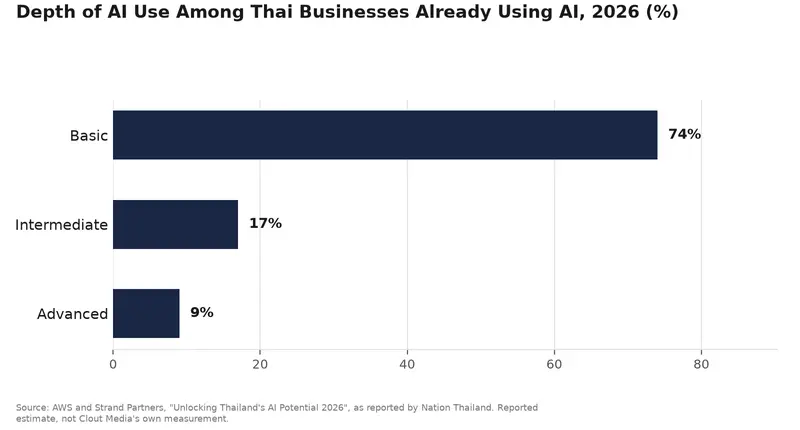
Depth of AI Use Among Thai Businesses Already Using AI, 2026 (%)
Basic: 74
Intermediate: 17
Advanced: 9
Source: AWS and Strand Partners, "Unlocking Thailand's AI Potential 2026", as reported by Nation Thailand. Reported estimate, not Clout Media's own measurement.
Trend 1: AI-Assisted Tools Move Design Effort From Production to Direction
Generative features are now part of everyday design software, and the effect on agency and freelancer work is already visible. Tasks that once took a designer an afternoon, such as resizing a campaign into ten formats, generating background variations or producing a first-pass layout, can now be done far faster. Survey data from Figma's 2025 AI report of 2,500 users illustrates the mood: 78% of respondents agree AI significantly enhances the efficiency of their work, yet only 32% say they can rely on its output, and only 31% of designers report using AI in core design work such as asset generation. Efficiency is real, but confidence is limited, and designers are more cautious than developers on both satisfaction and quality.
That gap explains where human effort is moving. Adobe's 2026 Creators' Toolkit survey of more than 16,000 creators in eight countries (Thailand not included) found that 75% describe creative AI as integrated or essential to how they work, while 85% say the final creative decision should always remain with the creator and 57% say outputs need moderate to extensive editing before publishing. In practice this means the scarce skill is no longer producing a first draft. It is briefing well, choosing among many options, correcting what looks plausible but is wrong, and keeping the result consistent with a brand. Agencies and freelancers who sell only production hours are exposed; those who sell direction, curation and quality control are better placed.
In Thailand, adoption appears broad but shallow. AWS and Strand Partners reported that 43% of Thai businesses now use AI consistently, but 74% of those adopters are at a basic stage, mostly using off-the-shelf tools for routine tasks, and skills shortages were cited by 51% of businesses. For design buyers this creates both an opportunity and a risk: cheap, fast output is easy to obtain, but distinctive, on-brand and legally safe output still takes skill. Clout Media's guide on whether AI can design your logo and brand identity looks at where AI helps in early exploration and where a system, not a single image, is still needed.
Trend 2: Design Systems Become the Operating Layer for Brand Consistency
As the number of assets a business produces rises, consistency stops being a matter of taste and becomes a matter of infrastructure. A design system, meaning a documented set of components, color, typography, spacing, imagery and, increasingly, motion rules, lets many different people produce work that still looks like one brand. This matters more when production is spread across an in-house team, agencies, freelancers and AI tools that will happily generate something off-brand if nobody tells them otherwise.
The benchmark data comes mostly from larger product organizations, but the direction is informative. In zeroheight's Design Systems Report 2026, based on 147 practitioners, 83% said their organization has a dedicated design system team, and 86% include design tokens, although only 40% have automated token pipelines. Adoption remains the hard part: only 7% reported their system as fully adopted across all teams, 61% said their team lacks the staff to meet its goals, and 46% were experimenting with AI in the process. Adobe's Asia Pacific findings, drawn from executives in Australia and New Zealand, India and Singapore rather than Thailand, add that 75% of brands said generative AI improved content production speed and 71% said it let non-creative teams produce content. More people producing content faster is exactly the situation in which guardrails matter.
Most Thai small and mid-sized businesses do not need an enterprise-scale system, and building one would be over-engineering. What they increasingly need is a lightweight version: a clear brand guideline, a small set of ready-to-edit templates for the channels they use most, and shared rules for how logos, colors, Thai and Latin typography and motion should behave. Clout Media's guide to what belongs in brand guidelines covers the practical contents, and the distinction between a brand system and one-off assets is explored further in brand design versus graphic design.
Trend 3: Short-Form, Motion and Social-First Design Become the Default Canvas
For most Thai consumers, a brand's first encounter is now a vertical video on a phone. DataReportal's Digital 2026: Thailand report, using data to October 2025, put social media user identities at 56.6 million, equal to 79.1% of the population, and TikTok's advertising reach at 56.6 million adults aged 18 and over, equal to 96.3% of that age group. These are audience-reach estimates rather than measures of attention, but they show that short-form video is the environment in which a great deal of Thai visual communication now succeeds or fails.
Video and commerce are also merging. According to the e-Conomy SEA 2025 report as reported by The Story Thailand, Thailand is the second-largest video commerce market in Southeast Asia, with 1.3 billion transactions and 850,000 video sellers, up 175% year on year. When a product is discovered, demonstrated and purchased inside one stream, design is no longer a wrapper around the sale. Thumbnails, on-screen text, price graphics, captions and transitions are part of the selling mechanism, usually produced quickly, in high volume, by small teams.
The design implication is that motion belongs inside the brand system rather than being improvised each time. Brands that handle this well tend to define vertical-first layouts with safe zones for platform interface elements, a small library of reusable templates for covers, titles and captions, and simple motion rules covering speed, easing and how the logo enters and exits. Thai typography deserves specific attention on small screens, because tone marks and vowels above and below the line can become illegible at small sizes or low contrast. Captions, which also serve viewers who watch without sound and viewers with hearing loss, are increasingly part of the design brief rather than an afterthought.
Trend 4: Accessibility and UX Move From Nice-to-Have to Baseline
Accessibility is often discussed as a compliance topic, but the data suggests it is first a craft-quality problem. The WebAIM Million 2026 report, which runs automated tests on the top one million home pages, found detectable WCAG 2 failures on 95.9% of them, up from 94.8% the year before, at an average of 56.1 errors per page. The most common issues were low-contrast text (83.9% of pages), missing image alternative text (53.1%), missing form input labels (51%), empty links (46.3%) and empty buttons (30.6%). These are largely design and front-end decisions that a careful team can avoid, and automated testing detects only a portion of real-world barriers, so these figures are a floor rather than a full audit.
The report also observes that pages using ARIA attributes averaged more errors (59.1) than pages without them (42), and links growing complexity to third-party frameworks and to automated or AI-assisted coding. The takeaway is not that new tools are bad, but that faster production makes review more important: a site assembled quickly from templates and generated code can look polished while failing basic tests such as contrast, labels and keyboard navigation.
In Thailand, the public-sector direction is clear even if the private-sector picture is less formal. The Digital Government Development Agency published guidance in May 2025 on developing government websites that persons with disabilities can use under Government Website Standard 3.0, recommending that agencies target at least WCAG Level AA. That guidance is aimed at government agencies rather than businesses, but it shows which benchmark Thai buyers, procurement teams and partners are likely to point to. Accessibility also overlaps with good UX generally: legible Thai type, strong contrast for outdoor mobile use and captions on video help every user.
Trend 5: Pricing and Procurement Shift From Hours to Scope, Outputs and Rights
If AI compresses production time, pricing by the hour becomes harder to defend, and buyers have noticed. Global research by the World Federation of Advertisers and MediaSense, published in November 2024 and based on a survey of more than 80 multinational advertisers representing over 60 billion dollars in global ad spend, found that three out of four were seeking to change their agency remuneration model within three years. Of those surveyed, 58% planned to increase their share of output-based or outcome-based pricing, and where AI is deployed, 58% expected to pay less. A May 2026 article in the Association of National Advertisers magazine, of which only the summary is public, says an ANA study finds most marketers satisfied with agency compensation while many plan changes amid concerns over transparency, rebates and AI-driven labor. These are multinational and US findings, not Thai SME data, but the direction is relevant.
In the Thai market, we found no published survey of design pricing, so the following is qualitative synthesis. Buyers are increasingly asking design partners to itemize what is included, to separate strategy and direction from production, to state how many formats and revisions are covered, and to be explicit about usage rights and file ownership. Fixed-scope packages and monthly retainers with defined output allowances suit fast, high-volume needs, while brand identity projects are still priced by depth of strategic work rather than number of files. Clout Media's guide to design work costs in Thailand explains what drives quotes, what a legitimate quote should itemize and how to compare proposals fairly.
Two newer procurement questions deserve a place in briefs. The first is disclosure: whether and where generative AI was used, and which tools. The second is rights. A Thai law firm commentary from May 2024 notes that the Copyright Act B.E. 2537 contains no provision expressly addressing AI-generated works, reports the Department of Intellectual Property's opinion that protection is reserved for human authors, and observes that Thai courts have yet to rule on the matter. This is commentary rather than legal advice, but the practical implication is to document human creative contribution and ask counsel about ownership before building a brand on AI-generated artwork. In Adobe's creator survey, 90% of respondents said copyright protection for AI-assisted work is important.
Trend 6: In-House Versus Agency Becomes a Hybrid Design Question
The choice between building an internal design team and hiring an agency has rarely been a clean either-or, and the available data suggests it is getting less so. The Association of National Advertisers' most recent in-house agency report, based on a 2023 survey of largely US member advertisers, found that 82% of members have an in-house agency, up from 42% in 2008. At the same time, 92% of those respondents also work with external agencies, mainly for bandwidth or for capabilities that do not exist internally, and an average of 61% of work is done in-house. Of the respondents, 65% had moved established business from external to in-house agencies over the previous three years, with cost efficiency the leading reason. This is a global benchmark of large advertisers, not a Thai one, and we found no comparable Thai survey.
Thai businesses face the same trade-offs at a different scale. An in-house designer or small team offers speed and brand familiarity for high-volume adaptation work such as resizing, template-based social posts and marketplace banners. An agency or specialist freelancer offers strategic thinking, depth in areas such as brand identity, motion and UX, and elastic capacity for launches. AI tools make it easier for a small internal team to output more, which strengthens the in-house case for routine work while raising the premium on outside strategy and craft.
The pattern that seems most workable is a division of labor rather than a winner. Agencies and specialists set the brand system, the templates and the motion and accessibility standards; in-house teams operate within them day to day; and both use a shared source of truth so that work stays consistent as people and tools change. The creative economy context supports a sizeable market for this kind of work: the Creative Economy Agency, as reported by Nation Thailand in January 2026, put Thailand's creative economy at 1.44 trillion baht, 8.01% of GDP, with advertising at 215 billion baht and design at 87 billion baht.
What This Means for Thai Businesses
Thailand is not simply importing global design trends; several of them are amplified by local conditions. High social and video usage, a leading video commerce market and a large base of small sellers mean the volume of visual content Thai businesses need is high relative to their design budgets. That is the environment in which AI-assisted production, templates and design systems earn their place, and also the one in which inconsistency, rights problems and inaccessible interfaces are easiest to create by accident.
The bilingual reality of Thai brands adds a practical layer. Typography, layout and copy have to work in Thai and English, on small screens, in motion and in static formats, often produced by different people. Guidelines that address Thai type and mixed-script layouts, and templates tested with real Thai copy, are more valuable here than generic global guidance.
For an owner or marketing lead, the practical implication is to treat design as an asset with maintenance needs rather than a one-off purchase. Businesses likely to benefit most invest once in a clear system, use AI tools for speed within those guardrails, keep human judgment on strategy and final approval, and make scope, rights and disclosure explicit in agreements.
Recommendations
Write down the brand rules before scaling production. A concise guideline covering logo use, color, Thai and Latin typography, imagery and motion gives every designer, agency and AI tool the same reference.
Build a small template library for your top channels. Cover vertical video covers, titles and captions, social posts and marketplace banners, and test them with real Thai copy.
Use AI for exploration and adaptation, and keep people in charge of judgment. Assign a named person to approve final work and to check for off-brand output, factual errors and look-alike imagery.
Add accessibility checks to the brief and the review. Test contrast, labels, alt text, keyboard use and captions before launch, and remember that automated tools catch only part of the problem.
Ask for itemized scope, revision limits and usage rights in every quote. Record who owns final files, whether generative AI was used, and how human creative contribution is documented.
Split work deliberately between in-house and external partners. Keep high-volume, template-based production close to the team and use outside specialists for identity, systems, motion and campaign peaks.
Review the system on a schedule. Revisit guidelines, templates and accessibility standards at least yearly.
Methodology & Sources Note
This report synthesizes publicly observable patterns in design, branding and creative production, drawing on the published third-party research and reporting listed in the Sources section. Several sources are global or non-Thai samples, which is stated wherever they are used, and figures that come through news reports are described as reported. Clout Media did not conduct primary research, surveys or proprietary data collection for this report, and the trend sections are qualitative synthesis unless a named source is given. We found no Thailand-specific published data on design pricing, design-system adoption or in-house versus agency mix, so those points are presented as directional observations. Nothing here is legal advice; treat this as a strategic orientation document rather than a substitute for advice on your own contracts, intellectual property or accessibility obligations.
If these shifts sound like they call for a partner who can build brand systems, templates and everyday design production for Thai and bilingual audiences, Clout Media Agency's design services are built around exactly this kind of consistent, multi-channel design support rather than one-off files.
Frequently Asked Questions
Will AI replace graphic designers in Thailand?
The evidence points to a change in the work rather than its disappearance. Survey data shows strong efficiency gains but low reliance on AI output, and most Thai business AI use is still at a basic stage. Production of routine assets is getting faster, while direction, curation, brand judgment and quality control remain human tasks.
Do small Thai businesses need a design system?
Not an enterprise-scale one, but a lightweight version is increasingly useful. A brand guideline, a few templates for your main channels and shared rules for logo, color, Thai and Latin type and motion help every person and tool produce consistent work as volume grows.
Why does short-form and motion design matter so much in Thailand?
Social media user identities reach roughly four in five Thais, TikTok's advertising reach covers most adults, and Thailand is reported to be the second-largest video commerce market in Southeast Asia. In that environment, vertical layouts, captions, thumbnails and motion rules are part of how a brand is seen and how a sale happens.
Is website and app accessibility legally required in Thailand?
Thai government agencies are guided toward at least WCAG Level AA under the government website standard, but we did not find a published requirement that applies the same rule to private businesses, and this report is not legal advice. Regardless of the legal position, accessible design improves usability, and buyers and partners increasingly expect it.
Who owns AI-generated design work in Thailand?
This is unsettled. A Thai law firm commentary from May 2024 reports that the Copyright Act has no provision expressly addressing AI-generated works, that the Department of Intellectual Property's reported view reserves protection for human authors, and that courts have not yet ruled. Documenting human contribution and taking legal advice before relying on AI-generated artwork is prudent.
Should we hire in-house designers or use an agency?
Many organizations do both. Global benchmark data from large advertisers shows most have an in-house team and still use external agencies for capacity and specialist skills. A practical split is in-house for high-volume, template-based work and external partners for brand identity, systems, motion and campaign peaks.
Sources
AWS and Strand Partners, "Unlocking Thailand's AI Potential 2026", as reported by Nation Thailand — https://www.nationthailand.com/business/tech/40068656
DataReportal, "Digital 2026: Thailand" — https://datareportal.com/reports/digital-2026-thailand
e-Conomy SEA 2025 (Google, Temasek, Bain & Company), as reported by The Story Thailand — https://www.thestorythailand.com/en/google-digital-economy-2/
Figma, "Figma's 2025 AI report: Perspectives From Designers and Developers" — https://www.figma.com/blog/figma-2025-ai-report-perspectives/
Adobe, "Creators' Toolkit Report 2026" — https://news.adobe.com/news/2026/06/creators-toolkit-report-2026
Adobe, "2026 AI and Digital Trends: Asia Pacific findings" — https://news.adobe.com/en/apac/news/2026/05/ai-digital-trends-asia-pacific
zeroheight, "Design Systems Report 2026" — https://report.zeroheight.com/
WebAIM, "The WebAIM Million 2026" — https://webaim.org/projects/million/
Digital Government Development Agency (DGA), guidance on accessible government websites under Government Website Standard 3.0 — https://standard.dga.or.th/article/5837/
World Federation of Advertisers and MediaSense, "Three-quarters of brands want to change their agency remuneration model" — https://wfanet.org/knowledge/item/2024/11/14/three-quarters-of-brands-want-to-change-their-agency-remuneration-model
Association of National Advertisers, "In-House Agencies No Longer A Trend, They're Here To Stay" — https://www.ana.net/content/show/id/79185
Association of National Advertisers magazine, client-agency relations article (members-only, headline only), May 2026 — https://www.ana.net/magazines/show/id/ana-2026-05-client-agency-relations
Creative Economy Agency figures, as reported by Nation Thailand — https://www.nationthailand.com/business/economy/40061152
WE IP, "AI-Generated Arts and Copyright: Thai Law Perspective" — https://weintellectual.com/ai-generated-arts-and-copyright-thai-law-perspective/
Ready to Hit YourTarget
Let's align your marketing strategy with our results-driven expertise.
Clout Media Co., Ltd.
1 Empire Tower , 27th Floor, Unit 2701-02, 2712-14 (27075), South Sathorn Road, Yannawa, Sathorn, Bangkok 10120
Email : info@cloutmediaagency.com
Tel : 096 646 2265