
Mobile App Development Trends in Thailand: 2026 Report

Executive Summary
Building a mobile app in Thailand in 2026 is no longer a single decision about "iOS or Android." It is a set of linked choices about where a business meets its customers, how much of the product should be shared across platforms, which intelligence features belong on the device and which in the cloud, and how much compliance and measurement work has to be planned before a line of code ships. This report synthesizes publicly observable shifts across the market: a mobile-first population that already does most of its e-commerce on phones, cross-platform frameworks that have become the default starting point for many business apps, AI features moving from novelty to a standard part of the app toolkit, LINE MINI Apps and installable web apps emerging as credible alternatives to a full native build, tighter store and platform rules that land on developers' calendars in 2026, and a growing recognition that retention, not downloads, decides whether an app earns its keep.
Key Findings at a Glance
Thailand is thoroughly mobile-first, with mobile connections equal to about 135% of the population and mobile reportedly accounting for roughly three quarters of e-commerce transactions; the open question is which type of app, not whether to be mobile.
Cross-platform frameworks are the default starting point for many business apps, while fully native builds remain the better fit where performance, deep device access, or platform-specific features are the product itself.
AI features are moving inside apps, with Apple and Google both offering on-device and hybrid routes, but Thai-language quality and data-sharing disclosure need explicit planning.
LINE MINI Apps have opened up to a much wider group of builders in Thailand, and installable web apps have become easier on iPhone, making "not a native app" a serious option.
Store and platform rules carry hard dates in 2026, including Google's Android developer verification starting in Thailand on 30 September 2026.
Thai data-protection enforcement now reaches developers and processors, not just the brands that commission apps.
Retention is the real scoreboard, since a large share of installs disappear within days.
Why This Report Matters Now
Most Thai businesses that commission an app today are not starting from zero. They already have a website, a LINE Official Account, a social presence, and often a marketplace storefront. The decision about a new app is therefore a decision about what a dedicated app adds on top of those channels, and as the alternatives have improved, the answer has become more nuanced.
At the same time, 2026 is a year in which the calendar itself is doing some of the work. Platform requirements from Google and Apple have effective dates that fall inside ordinary release cycles, Thailand's data-protection regulator has moved from awareness-building to issuing fines, and AI features have made it easy to add capabilities that also add disclosure duties, testing burdens, and ongoing running costs. This report is an orientation for owners, marketers, and product managers who want to understand where the market is heading before they write a brief. It is not a substitute for technical scoping, legal advice, or a budget built from a real feature list.
Key Data Points
The figures below combine Thailand-specific data with labeled global benchmarks. They come from the third-party sources named in the table, not from Clout Media's own research, and global figures are context rather than measurements of the Thai market.
Thailand mobile and internet reach: 96.6 million cellular mobile connections in late 2025 (135% of the population) and 67.8 million internet users (94.7% penetration) — DataReportal, "Digital 2026: Thailand"
Mobile in Thai e-commerce: Mobile commerce reportedly accounts for 74% of e-commerce transactions in Thailand, and apps are the most used way to shop online at 65% of transactions (figures attributed to ETDA; year not stated) — U.S. International Trade Administration, Thailand Country Commercial Guide: eCommerce (published 2026-04-09)
LINE in Thailand: 56 million monthly active users (78.2% of the population); more than 1,000 services on LINE MINI App, with the number of MINI Apps reportedly up threefold and daily active users up fourfold after self-service publishing opened in March 2026 — DataReportal; LINE Thailand Business Insight 2026 press release
Global app usage (2025): $167 billion in in-app purchase revenue, nearly 150 billion downloads, and 5.3 trillion hours spent in apps (about 3.6 hours per user per day); generative AI app downloads reportedly doubled to 3.8 billion — Sensor Tower, "State of Mobile 2026" (global)
Global uninstall rate (2024): 46.1% of Android app installs were uninstalled within 30 days, and most uninstalls happen on the first day — AppsFlyer, "App Uninstall Report 2025 Edition" (global)
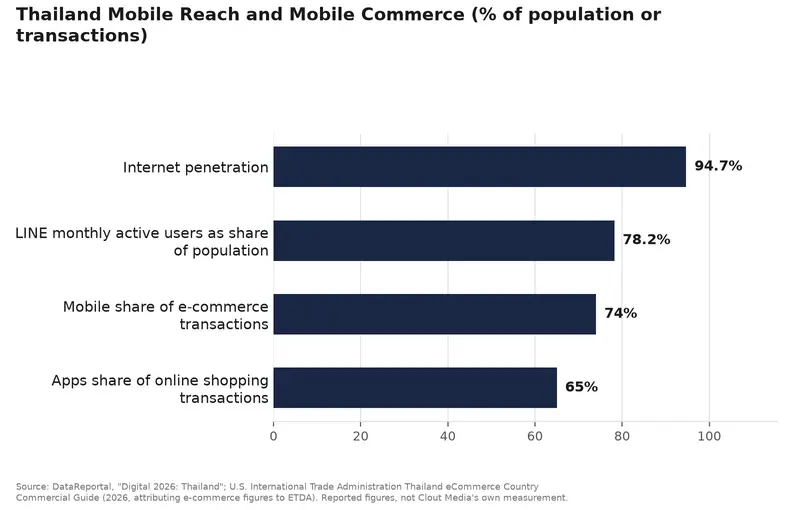
Thailand Mobile Reach and Mobile Commerce (% of population or transactions)
Internet penetration: 94.7
LINE monthly active users as share of population: 78.2
Mobile share of e-commerce transactions: 74
Apps share of online shopping transactions: 65
Source: DataReportal, "Digital 2026: Thailand"; U.S. International Trade Administration Thailand eCommerce Country Commercial Guide (2026, attributing e-commerce figures to ETDA). Reported figures, not Clout Media's own measurement.
Trend 1: Mobile-First Usage Turns "Do We Need an App?" Into a Channel Decision
Thailand's connectivity numbers explain why mobile is the default surface for consumer businesses. DataReportal reports roughly 96.6 million cellular mobile connections in late 2025, equivalent to 135% of the population, alongside 67.8 million internet users. The U.S. International Trade Administration's 2026 country guide, citing ETDA, adds that mobile commerce accounts for 74% of Thai e-commerce transactions and that apps are the most used method to shop online. In a market like this, the debate is rarely whether customers are on their phones. It is what they are doing there and which surface they expect to find a business on.
That distinction matters because a phone is not the same as an app. A Thai customer may reach a business through a LINE chat, a marketplace store, a social video, a mobile website, or a delivery platform long before installing anything new. A new branded app has to earn a place on a home screen that is already crowded, which is a much higher bar than earning a click.
An app brief should start with a job to be done. Frequent, repeated interactions with logged-in users, such as loyalty, ordering, booking, memberships, field operations, and account management, tend to justify a dedicated app. One-off or occasional interactions, such as a quote request or a single purchase, often do not, and may be served better by an existing channel. Clout Media's overview of mobile app development cost in Thailand explains how feature scope, rather than the word "app," is what drives the size of a project.
Trend 2: Cross-Platform Is the Default Starting Point; Native Is a Deliberate Choice
For a growing share of Thai business apps, the first technical question is no longer "native for iOS and Android, or hybrid?" but "is there a reason not to share a codebase?" Cross-platform frameworks such as Flutter and React Native let one team build most of the interface and logic once and ship to both stores. The Stack Overflow Developer Survey 2024 found that 9.4% of all respondents used Flutter and 8.4% used React Native, which are global figures across all kinds of developers rather than mobile specialists alone. JetBrains' Developer Ecosystem surveys, as cited in Kotlin's documentation, show Kotlin Multiplatform usage among respondents rising from 7% in 2024 to 18% in 2025, a sign that the shared-code approach is diversifying beyond two frameworks.
A shared codebase means one set of features to design, build, test, and maintain, rather than two parallel efforts that drift apart over time. For booking systems, ordering apps, loyalty programs, service marketplaces, and internal tools, the user-facing difference is often small, and the saved effort can go into the parts customers actually notice, such as onboarding, speed of key flows, and clarity of design.
Native development has not gone away, and it should be a deliberate choice rather than a default. It remains the stronger option where the product depends on intensive graphics, deep sensor or camera work, real-time processing, or immediate access to new platform capabilities. That is increasingly relevant to AI, because Apple's on-device model framework, for example, is a Swift API. For a fuller comparison of trade-offs in cost, speed, and long-term maintenance, see Clout Media's guide to native vs hybrid app development.
Trend 3: AI Features Move Inside the App, on the Device and in the Cloud
AI has shifted from a headline feature to an ordinary ingredient in app design. Sensor Tower's State of Mobile 2026 reports that generative AI app downloads doubled to 3.8 billion in 2025, in-app purchase revenue in those apps nearly tripled to more than $5 billion, and time spent reached 48 billion hours, roughly 3.6 times the 2024 total.
The platforms have made this easier to build. Apple's Foundation Models framework, introduced with iOS 26, gives developers access to an on-device model of roughly 3 billion parameters that works offline and keeps prompts on the device, with inference that is free of cost to developers. On Android, Google's ML Kit GenAI APIs expose Gemini Nano for tasks such as summarization and rewriting, and Firebase hybrid inference, described in a July 2026 Android Developers Blog post, lets an app route requests between on-device and cloud models to balance latency, cost, and offline availability.
Three Thai-specific cautions belong in any AI feature brief. First, language: Apple's published Apple Intelligence language list does not currently include Thai, and none of the vendor announcements reviewed for this report state Thai-language quality for their on-device models, so Thai output should be tested directly, feature by feature and device by device, with a cloud fallback if needed. Second, disclosure: Apple's App Review Guidelines require apps to clearly disclose where personal data is shared with third parties, including third-party AI, and to obtain explicit permission first, which has direct design implications for chat and assistant features. Third, running cost: cloud AI turns a one-time build into a usage-based expense that should be modeled early. AI also changes how apps get built, not just what they do; Clout Media's discussion of whether AI can build your app covers where AI-assisted development helps and where production requirements still need experienced engineers.
Trend 4: LINE MINI Apps, Super-App Ecosystems, and Web Apps Become Real Alternatives
LINE, one of Thailand's most widely used apps, is also a distribution platform. DataReportal reports 56 million LINE monthly active users in Thailand, about 78.2% of the population. LINE MINI App is designed as an app-in-app layer: according to LINE's developer documentation, it lets users enjoy services without installing a separate native app, runs as a web application inside LINE, and can be reached through Official Account rich menus, LINE search, links and QR codes, and sharing between friends.
What changed in 2026 is access. LINE Developers announced that as of 11 March 2026, anyone can publish LINE MINI Apps in Thailand and Taiwan as unverified apps, with the verification review reserved for channels under a certified provider. LINE Thailand's 2026 business insight release reports that more than 1,000 services are now available on LINE MINI App in Thailand, that the number of MINI Apps has grown threefold and daily active users fourfold since self-service publishing began, and that participating merchants in its LINE MINI Eats food-and-beverage solution grew fivefold within a quarter of launch.
Installable web apps are the other alternative. Apple's WebKit team announced that in Safari 26, every website added to the Home Screen opens as a web app by default, which removes a configuration step that used to make this route awkward on iPhone. Web apps still do not offer App Store distribution or the deepest hardware access, so they are not a replacement for every native product, but they are a strong option for content, catalog, and lightweight transactional experiences, and they build on the same website investment discussed in Clout Media's website development trends report.
Trend 5: Store Rules, Security, and PDPA Now Shape Cost and Timeline
Several platform requirements land in 2026, and they affect both scheduling and cost. Google's Android developer verification is scheduled to begin on 30 September 2026 for users in Brazil, Indonesia, Singapore, and Thailand. Google says the protections apply to apps installed from participating stores on certified Android 7+ devices, that Google Play automatically registers 99% of Play apps, and that verification will expand globally in 2027. Separately, Google Play's target-API policy requires new apps and updates to target Android 16 (API level 36) from 31 August 2026, with an extension request available to 1 November 2026. On the Apple side, apps uploaded to App Store Connect have had to be built with Xcode 26 or later, using the iOS 26 SDK, since 28 April 2026.
Store policy also dictates features. Apple's guidelines require that apps supporting account creation also offer account deletion within the app, and Google Play requires an in-app deletion path plus a web link, along with completed Data safety declarations. Both belong in the initial scope alongside login, consent, and permission prompts.
Thai law adds another layer. In August 2025, Thailand's Personal Data Protection Committee announced eight administrative fines totaling about THB 14.5 million, according to a law-firm summary from Nagashima Ohno & Tsunematsu. Commentary from Tilleke & Gibbins identifies recurring failures such as inadequate security measures, failure to report breaches, and failure to appoint a Data Protection Officer. Notably for app teams, the cases included a THB 3 million fine on a data processor that developed a reservation system after hackers accessed it and altered roughly 200,000 personal data items, and a fine of THB 153,120 on a system development company in a case involving a state agency's web application. The lesson is that processors and developers can be held accountable alongside the businesses that commission them. For budgets and timelines, this translates into real line items: access control, secure storage, data-processing agreements, breach procedures, consent design, and testing, most of which sit outside the visible interface that quotes tend to focus on.
Trend 6: Retention and Measurement Replace Downloads as the Scoreboard
Global retention data is sobering. AppsFlyer's uninstall report found that 46.1% of Android installs in 2024 were uninstalled within 30 days, that the majority of uninstalls happen on the first day, and that the analysis covered 2.2 thousand apps and 1.3 billion installs. A separate compilation of AppsFlyer, Adjust, and data.ai benchmarks published by UXCam reports median retention of roughly 25% on Day 1, 8% on Day 7, and 4% on Day 30 across categories, with e-commerce lower and fintech higher. None of these figures is specific to Thailand, and AppsFlyer's own benchmarks group Thailand into a wider Southeast Asia sub-region, so businesses should treat them as a reminder of the shape of the curve rather than a target to aim for.
The implication is that the first session carries disproportionate weight, so onboarding and re-engagement matter more than a large launch campaign.
Measurement deserves as much design attention as features. A useful plan defines a small set of events tied to real business outcomes, such as registration, first booking, first purchase, and repeat purchase, and tracks cohorts over time rather than daily download totals. It must also respect consent: Apple's guidelines require permission through App Tracking Transparency to track users, and PDPA obligations apply wherever analytics data can identify individuals. Teams that define events, consent, and dashboards before launch avoid the common situation of having a live app and no reliable answer to whether it is working.
What This Means for Thai Businesses
Thailand is a favorable market for mobile products because the audience is already there, connected, and accustomed to transacting on phones. Customers are used to polished experiences from large platforms, have limited patience for slow or confusing flows, and already carry a full home screen. For most businesses, the winning move is not to build the biggest possible app but to choose the lightest surface that does the job, and to invest properly in the parts that decide whether it works: performance, onboarding, security, and measurement.
Thai businesses also have a structural advantage in LINE. Because most of the population already uses it, a MINI App or Official Account integration can offer a lower-friction way to test a service before committing to a standalone app, and the 2026 opening of self-service publishing makes experimentation cheaper. A sensible pattern for many organizations is to validate demand through LINE or an installable web app, then invest in a cross-platform app once usage, frequency, and revenue justify it.
The Android verification date, the target-API and Xcode requirements, and PDPA enforcement all reward teams that plan them in, and penalize teams that discover them during store review or after an incident.
Recommendations
Start with the job to be done, not the platform. Decide whether the interaction is frequent and logged-in enough to justify a dedicated app, or whether a LINE MINI App, LINE Official Account flow, or installable web app would serve it more lightly.
Default to a shared codebase and justify native exceptions. Choose a cross-platform approach for most business apps, and reserve native modules for features that truly need performance or immediate platform access.
Scope AI features with language, disclosure, and running cost in mind. Test Thai-language quality directly, plan explicit user permission wherever personal data reaches a third-party AI service, and estimate usage-based cloud costs before committing.
Put the 2026 platform deadlines on the project calendar. Confirm Android developer registration, Google Play target-API level, and the Xcode 26 build requirement with the development team before release dates are set.
Treat PDPA and security as scope, not extras. Include consent design, access control, secure storage, processor agreements, breach procedures, and account deletion in the initial estimate, and clarify contractually who holds each responsibility.
Design retention and measurement before launch. Define a handful of outcome-linked events, plan onboarding and re-engagement together with acquisition, and review cohorts rather than download counts.
Methodology & Sources Note
This report synthesizes publicly observable patterns in Thai and global mobile app development, drawn from platform announcements, developer documentation, published industry reports, and general industry practice. The figures cited above come from the named third-party sources listed under Sources. Global figures are labeled as global, and company-reported figures are labeled as reported. Clout Media did not conduct primary research, surveys, or proprietary data collection for this report, and the trend sections are qualitative synthesis unless a named source is given. Platform dates and policies change frequently, and nothing here is legal advice, so businesses should confirm current requirements with the platforms and qualified counsel before acting.
If these shifts sound like they call for a partner who can help scope the right kind of app for the Thai market, from cross-platform builds to LINE-based experiences, Clout Media Agency's app development services are built around a practical, requirements-first approach rather than a one-size-fits-all build.
Frequently Asked Questions
Does my Thai business need a native mobile app in 2026?
Not necessarily. Mobile use in Thailand is very high, but customers also reach businesses through LINE, marketplaces, and social platforms. A dedicated app tends to make sense for frequent, logged-in interactions such as ordering, loyalty, and bookings. For occasional interactions, a LINE MINI App or an installable web app may be a lighter and faster option.
Is cross-platform development good enough, or should we build native?
For many business apps, a cross-platform framework such as Flutter or React Native is a sound default because one shared codebase reduces effort and speeds up releases. Native development remains a better fit for graphics-heavy, sensor-heavy, or real-time products and for teams that need immediate access to new platform features.
Can I add AI features to my app, and will they work in Thai?
Yes, both Apple and Google provide routes for on-device and hybrid on-device and cloud AI. Thai-language quality is not guaranteed by these announcements, and Apple's published Apple Intelligence language list does not include Thai, so features should be tested directly with Thai content. You should also plan user permission for sharing personal data with third-party AI and budget for cloud usage costs.
What is a LINE MINI App, and who can publish one?
A LINE MINI App is a web-based app that runs inside LINE, so users do not install anything separate. Since 11 March 2026, anyone meeting LINE's policy requirements can publish an unverified MINI App for Thailand, while the verification review is limited to channels under a certified provider.
What changes for app developers in Thailand in 2026?
Google's Android developer verification begins on 30 September 2026 for Brazil, Indonesia, Singapore, and Thailand. Google Play requires new apps and updates to target API level 36 from 31 August 2026 unless an extension to 1 November 2026 is granted, and Apple has required Xcode 26 builds since 28 April 2026.
What is a good retention rate for a new app?
There is no single Thailand-specific benchmark to rely on. Globally, AppsFlyer reports that 46.1% of Android installs were uninstalled within 30 days in 2024, and a compilation of industry benchmarks reports median Day 30 retention of around 4%. Your own cohorts over time are the most useful comparison.
Sources
DataReportal, "Digital 2026: Thailand" — https://datareportal.com/reports/digital-2026-thailand
U.S. International Trade Administration, "Thailand eCommerce" Country Commercial Guide (published 2026-04-09) — https://www.trade.gov/country-commercial-guides/thailand-ecommerce
LINE Thailand Business Insight 2026 press release (ThaiQuest) — https://pr.thaiquest.com/post/747849
LINE Developers, "LINE MINI App: Introduction" — https://developers.line.biz/en/docs/line-mini-app/discover/introduction/
LINE Developers, News 2026 (11 March 2026 MINI App announcement) — https://developers.line.biz/en/news/2026/
Sensor Tower, "2026 State of Mobile" — https://sensortower.com/blog/state-of-mobile-2026
AppsFlyer, "App Uninstall Report 2025 Edition" — https://www.appsflyer.com/resources/reports/app-uninstall-benchmarks-report/
AppsFlyer, App Marketing Benchmarks FAQ — https://www.appsflyer.com/benchmarks/faq/
UXCam, "Mobile App Retention Benchmarks by Industry (2026)" — https://uxcam.com/blog/mobile-app-retention-benchmarks/
Stack Overflow Developer Survey 2024, Technology — https://survey.stackoverflow.co/2024/technology
Kotlin Multiplatform documentation (citing JetBrains Developer Ecosystem surveys) — https://kotlinlang.org/docs/multiplatform/kotlin-multiplatform-react-native.html
Apple Newsroom, "Apple's Foundation Models framework unlocks new intelligent app experiences" — https://www.apple.com/newsroom/2025/09/apples-foundation-models-framework-unlocks-new-intelligent-app-experiences/
Apple Developer, "What's new in the Foundation Models framework" (WWDC26) — https://developer.apple.com/videos/play/wwdc2026/241/
Apple, Apple Intelligence supported languages — https://www.apple.com/apple-intelligence/
Android Developers Blog, "The latest Gemini Nano with on-device ML Kit GenAI APIs" (August 2025) — https://android-developers.googleblog.com/2025/08/the-latest-gemini-nano-with-on-device-ml-kit-genai-apis.html
Android Developers Blog, "Build intelligent Android apps: Cloud and hybrid inference" (July 2026) — https://android-developers.googleblog.com/2026/07/build-intelligent-android-apps-cloud-hybrid-inference.html
Android Developers Blog, "Android developer verification" (June 2026) — https://android-developers.googleblog.com/2026/06/android-developer-verification.html
Android Developers, "Android developer verification" — https://developer.android.com/developer-verification
Google Play Console Help, "Target API level requirements" — https://support.google.com/googleplay/android-developer/answer/11926878
Google Play Console Help, "Account deletion requirements" — https://support.google.com/googleplay/android-developer/answer/13327111
Apple Developer, "Upcoming Requirements" — https://developer.apple.com/news/upcoming-requirements/
Apple Developer, "App Review Guidelines" — https://developer.apple.com/app-store/review/guidelines/
WebKit, "News from WWDC25: Web technology coming in Safari 26 beta" — https://webkit.org/blog/16993/news-from-wwdc25-web-technology-coming-in-safari-26-beta/
Nagashima Ohno & Tsunematsu, "Huge Fines Imposed by Thailand's PDPC" — https://www.nagashima.com/en/publications/publication20250822-1/
Tilleke & Gibbins, "More Than a Warning: Eight Serious Fines Imposed in Thai Data Protection Cases" — https://www.tilleke.com/insights/more-than-a-warning-eight-serious-fines-imposed-in-thai-data-protection-cases/
Ready to Hit YourTarget
Let's align your marketing strategy with our results-driven expertise.
Clout Media Co., Ltd.
1 Empire Tower , 27th Floor, Unit 2701-02, 2712-14 (27075), South Sathorn Road, Yannawa, Sathorn, Bangkok 10120
Email : info@cloutmediaagency.com
Tel : 096 646 2265