
2026 Website Development Trends Report for Thai Businesses
Executive Summary
Business websites are being pulled in two directions at once. On one side, AI-assisted development tools have made it faster and cheaper to produce a working site, compressing timelines that used to require a full production team. On the other, the bar for what counts as an acceptable website has risen sharply: visitors expect instant load times, seamless mobile interactions, and integrated payments or booking without a phone call; and increasingly, a website's audience is not only human — it is also the AI systems and answer engines that summarize, cite, or recommend a business on someone else's behalf. This report steps back from single-topic questions like cost or timeline and looks at the broader shape of where business websites, as a category, are heading through 2026. It examines five forces reshaping what a "good website" means: the real, bounded role of AI in development workflows; rising performance expectations tied directly to Core Web Vitals; the emergence of AI-crawler citability as a parallel discipline to traditional SEO; the shift from "mobile-friendly" to genuinely app-like mobile experiences; and the normalization of integrations that used to be considered premium features. For Thai businesses, these shifts arrive layered on top of an already mobile-first, LINE-centric market, which changes how each trend should be prioritized and implemented.
Key Findings at a Glance
AI-assisted development is now standard practice, but it accelerates execution rather than replacing engineering judgment on architecture, security, and complex integrations.
Core Web Vitals and raw page speed have moved from a "nice to have" to a baseline trust and ranking signal, with slow sites increasingly read as a proxy for an unreliable business.
Websites are being read by machines as often as by people, making structure, clarity, and machine-parseable content a competitive factor rather than a technical afterthought.
"Mobile-friendly" is no longer sufficient — the expectation is shifting toward app-like responsiveness, gesture support, and near-native interaction patterns on phones.
Payments, booking, CRM sync, and live chat are becoming baseline features expected on launch day, not upsells added months later.
Security and privacy signals (HTTPS, clear data handling, visible trust markers) are increasingly treated as a proxy for overall business credibility.
The businesses gaining the most ground are combining AI-accelerated build speed with human oversight of strategy, structure, and integration decisions — not choosing one over the other.
Why This Report Matters Now
Most conversations about business websites still center on cost, timeline, or which platform to use — practical questions with fairly stable answers. What has changed is the underlying environment those decisions sit in. Search behavior is fragmenting across traditional search engines, AI chat assistants, and in-platform answer boxes; visitor expectations for speed and interactivity have been set by the best apps and sites in the world, not by local competitors; and the tooling used to build websites has shifted meaningfully in the last two years. Any one of these shifts alone would justify a revisit of website strategy. Together, they represent a genuine inflection point: a website built to 2022 standards — even a functional, good-looking one — can now quietly underperform on metrics that did not exist as priorities a few years ago, from machine-readability to interaction responsiveness. This report is intended to give business owners and marketing leads a higher-altitude view of that shift, separate from the tactical questions already covered elsewhere.
Key Data Points
While most of this report is deliberately qualitative, a handful of recent third-party data points help put real scale behind two of the trends below. These figures come from published external research, not from Clout Media's own testing or client data, and are attributed accordingly.
Core Web Vitals overall pass rate: Reportedly 55.9% of tracked website origins pass all three Core Web Vitals thresholds, per the May 2026 CrUX data release — Google Chrome UX Report (CrUX), May 2026
"Good" Largest Contentful Paint (LCP): 68.6% of origins reportedly achieve a "good" LCP score — Google Chrome UX Report (CrUX), May 2026
Interaction to Next Paint (INP) failure rate: An estimated 43% of sites still fail the 200ms INP threshold, even though 86.6% achieve "good" INP overall — Google Chrome UX Report (CrUX), May 2026
Bot vs. human web traffic: According to Cloudflare Radar data cited by CEO Matthew Prince, automated bot traffic reportedly accounts for roughly 57.5% of HTML web traffic, versus 42.5% from humans — Cloudflare Radar, June 2026
AI-related crawler share of verified bot traffic: Within verified bot traffic, AI crawlers reportedly represent about 20.3%, with AI-search bots adding a further 6.5% — roughly 26.7% combined — Cloudflare Radar, June 2026
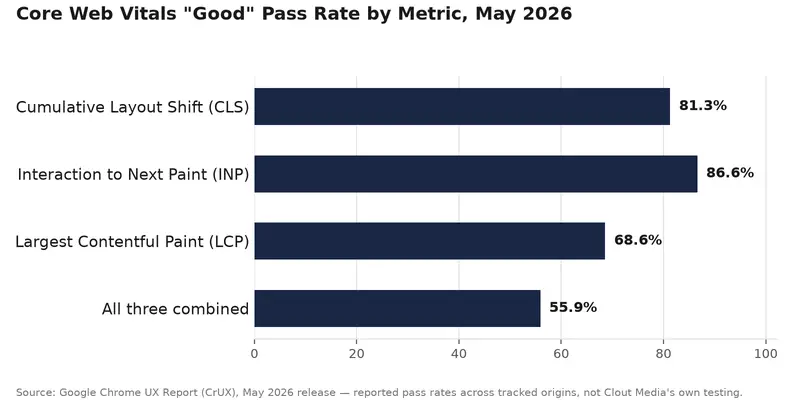
Core Web Vitals "Good" Pass Rate by Metric, May 2026
Cumulative Layout Shift (CLS): 81.3
Interaction to Next Paint (INP): 86.6
Largest Contentful Paint (LCP): 68.6
All three combined: 55.9
Source: Google Chrome UX Report (CrUX), May 2026 release — reported pass rates across tracked origins, not Clout Media's own testing.
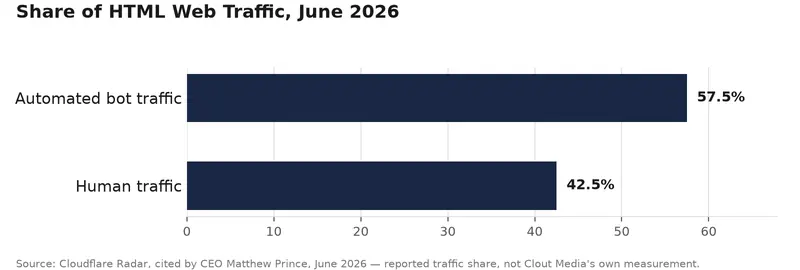
Share of HTML Web Traffic, June 2026
Automated bot traffic: 57.5
Human traffic: 42.5
Source: Cloudflare Radar, cited by CEO Matthew Prince, June 2026 — reported traffic share, not Clout Media's own measurement.
Trend 1: AI-Assisted Development Finds Its Real Place in the Workflow
AI coding assistants and website builders have moved past the hype phase into something more useful and more limited than early claims suggested. In practice, AI tools now meaningfully speed up specific parts of the development process: scaffolding page layouts, generating first-draft copy, producing boilerplate code, and handling repetitive front-end work that used to consume junior developer hours. This is a genuine efficiency gain, and businesses that ignore it are leaving time and budget on the table.
What AI tools do not reliably do is replace the judgment required for anything beyond a simple, templated site. Complex information architecture, secure payment integrations, custom booking logic, performance tuning, and the accessibility and edge-case handling that separates a professional site from a prototype still require experienced human oversight. AI-generated code frequently needs review for security gaps, inefficient patterns, and structural decisions that will cause problems as a site scales. The realistic picture for 2026 is a hybrid workflow: AI tools compress the mechanical parts of building a site, while developers spend more of their time on architecture, integration, quality assurance, and the strategic decisions AI cannot make on its own. Agencies and in-house teams that treat AI as a productivity multiplier — rather than a replacement for technical expertise — are the ones producing sites that hold up under real traffic and real business requirements. This distinction matters directly for buyers evaluating options, including the growing number of no-code and AI website builder tools now marketed to small businesses.
Trend 2: Performance and Core Web Vitals Become a Baseline Expectation
Site speed has been a ranking factor for years, but 2026 marks a shift in how central it has become to both user experience and search visibility. Core Web Vitals — metrics covering loading performance, interactivity, and visual stability — are no longer a specialized technical concern handled quietly in the background. They are now a visible, measurable proxy for whether a business takes its digital presence seriously, and search engines continue to weight them more heavily as a ranking input alongside content relevance. The gap between metrics that have improved and ones that haven't is telling: even as most tracked sites now post "good" scores on individual Core Web Vitals metrics, an estimated 43% of sites still fail the 200ms Interaction to Next Paint (INP) threshold — the metric most directly tied to how responsive a site feels when a visitor taps or clicks.
The practical effect is that a beautiful website that loads slowly, or one that shifts content around as it loads, is now a competitive liability in a way it was not five years ago. Visitor tolerance for lag has not increased — if anything, expectations set by fast, well-engineered apps and platforms have made slow business websites feel more conspicuously outdated. This is compounded by the reality that most traffic to Thai business websites arrives on mobile connections of varying quality, where inefficient image loading, bloated scripts, and unoptimized third-party embeds (widgets, trackers, chat plugins) have an outsized negative effect. Performance is no longer something to fix after launch; it needs to be a design constraint from the first wireframe, influencing decisions about image formats, hosting, code structure, and which third-party scripts actually earn a place on the page.
Trend 3: Structuring Content for AI Crawlers, Not Just Human Readers and Search Engines
Perhaps the most structurally new trend in this report is the growing need to write and organize website content so that AI systems — the crawlers behind AI Overviews, chat-based answer engines, and other generative tools — can parse, understand, and accurately cite it. This is a meaningfully different discipline from traditional SEO, even though the two overlap. This is not a niche concern: automated bot traffic reportedly now accounts for roughly 57.5% of HTML web traffic on the web, more than the share coming from human visitors, and within verified bot traffic, AI crawlers and AI-search bots together are estimated to make up roughly 26.7% — a fast-growing audience most business websites have not been structured for at all.
Traditional SEO optimizes for a human scanning a results page and a search algorithm ranking pages by relevance and authority signals. AI-crawler citability optimizes for something else: a language model reading a page's content and deciding whether it contains a clear, extractable, trustworthy answer worth summarizing or quoting. This rewards content that states facts plainly, structures information with clear headings and logical hierarchy, avoids burying key information in decorative language, and uses well-implemented Organization and Article structured data (schema markup) to help machines understand what a page is and who published it. It does not reward keyword stuffing or content written primarily to game rankings — if anything, the shift punishes that kind of writing more than traditional search did, because it is harder for a language model to extract a clean answer from vague or padded text. Businesses that have historically treated their website as a static brochure are the most exposed here: if AI systems cannot parse a site's content clearly, that business becomes invisible in an increasingly important channel, regardless of how well-designed the page looks to a human visitor.
Trend 4: Mobile-First Becomes App-Like by Default
"Mobile-friendly" was the standard a decade ago: a responsive layout that did not break on a phone screen. That bar has moved substantially. The current and emerging expectation is for business websites to feel closer to native apps — fast transitions, thumb-friendly navigation, minimal friction between intent and action (like tapping to call, chat, or check out), and interface patterns borrowed directly from the apps people use daily.
This shift is driven by simple exposure: consumers spend the overwhelming majority of their digital time in a small number of extremely well-designed apps, and that experience recalibrates what feels acceptable everywhere else, including on a business's own website. A site that merely "works" on mobile, without attention to gesture support, load-triggered animations that feel janky, or forms that are painful to fill out on a small screen, now reads as noticeably behind. This is especially consequential in markets where mobile is not just the primary but often the only device many customers use to research and transact with a business, which raises the practical stakes of getting this right far beyond a cosmetic concern.
Trend 5: Integrations Move from Premium Add-On to Baseline Expectation
A website that exists purely as a digital brochure — information and a contact form — is increasingly seen as incomplete by visitors who have been trained by other experiences to expect a business to do more directly on its site. Payment processing, appointment or table booking, CRM synchronization so that a lead does not disappear into an inbox, and live chat (including chat-app integrations) have shifted from being differentiators that justified a premium price tag to being assumed features of any serious business website.
This shift changes the calculus for how a website should be planned rather than just built. Integrations that used to be scoped as "phase two" additions are increasingly expected at launch, because visitors who hit a wall — no online payment option, no way to book without calling — will often simply move to a competitor who removed that friction. It also raises the technical bar for what a website project actually requires: connecting a booking system or CRM properly, and keeping that connection secure and reliable over time, is a meaningfully different scope of work than designing pages, and it is one of the areas where the earlier point about AI-assisted development's limits is most relevant — this is not the kind of integration work that a template or a quick AI-generated script reliably handles well on its own.
Trend 6: Security and Privacy as a Trust Signal, Not Just a Technical Checkbox
Security used to be an invisible layer that mattered mostly when something went wrong. That is changing. Basic markers — a valid HTTPS certificate, transparent handling of customer data, visible privacy information, and a site that does not throw browser security warnings — are increasingly interpreted by visitors, even non-technical ones, as a signal of whether a business can be trusted with their information or their payment details. Search engines and browsers have also made these signals more visible to end users over time, rather than leaving them buried in technical details only specialists would notice.
For any website handling payments, bookings, or customer data — which, per Trend 5, is becoming most business websites — this means security can no longer be treated as a one-time setup task. It needs ongoing attention: keeping software and plugins updated, monitoring for vulnerabilities, and being able to clearly explain to a customer how their data is handled. Businesses that get this right are not just avoiding risk; they are building a form of quiet credibility that increasingly influences whether a visitor completes a transaction at all.
What This Means for Thai Businesses
These global trends do not land the same way in every market, and Thailand's digital environment has specific characteristics that change how each should be prioritized. Mobile usage in Thailand is not just heavy — for a large share of consumers, the phone is the primary or only way they interact with businesses online, which makes Trend 4's shift toward app-like mobile experiences less of a future consideration and more of an immediate one. A website that is merely "responsive" but slow or clunky on a mid-range Android phone, which represents a large share of the actual device market, is a real business cost.
LINE's central role in Thai commerce and customer service adds a layer that does not map directly onto global conversations about "chat integration." For most Thai businesses, chat integration specifically means LINE Official Account connectivity — click-to-chat links, LINE-based booking confirmations, and customer service handoffs that keep a conversation inside the platform customers already use daily, rather than routing them to a generic contact form. This should be treated as a default requirement under Trend 5, not an optional extra.
Local payment method support is another area where global integration trends need local translation: Thai consumers expect options like PromptPay QR payments, mobile banking app integration, and familiar local payment gateways, not just credit card processing designed primarily for international card networks. A booking or e-commerce flow that only supports card payments is incomplete for much of the Thai market. Finally, the AI-crawler citability trend (Trend 3) has a bilingual dimension for Thai businesses serving both local and international audiences: content needs to be structured clearly in both Thai and English where relevant, since AI systems parsing and citing content do not automatically bridge poorly structured or purely marketing-toned copy in either language. Businesses that treat their Thai-language content with the same structural discipline as their English content will be better positioned as AI-driven discovery channels grow.
Recommendations
Audit your current site against Core Web Vitals before planning any redesign — performance problems are often cheaper to fix than a full rebuild, and fixing them first clarifies what a redesign actually needs to solve.
Treat AI development tools as an acceleration layer, not a replacement for technical review — use them for drafts and scaffolding, but have experienced developers own architecture, security, and integration decisions.
Restructure key pages so their core facts and answers are stated plainly near the top, with clear headings and logical hierarchy, so both human visitors and AI systems can extract the information without wading through marketing language.
Scope payment, booking, CRM, and LINE OA integration into the initial project, not as a later phase — these are now baseline expectations, and retrofitting them is usually more disruptive than building them in from the start.
Make mobile performance on mid-range Android devices a specific, tested requirement, not just a visual responsiveness check, given how much Thai traffic arrives on these devices.
Review security and data-handling basics — HTTPS, update cadence, visible privacy information — as part of routine site maintenance, not a one-time launch task, since these signals compound into overall business trust.
Methodology & Sources Note
This report synthesizes publicly observable industry trends and patterns in web development, search behavior, and digital design as of late 2025 and into 2026. Where specific figures are cited — such as the Core Web Vitals and bot-traffic data in the Key Data Points section above — they are drawn from published third-party technical sources (Google's Chrome UX Report and Cloudflare Radar, both cited above and in the Sources section at the end of this report), not from Clout Media's own primary research or proprietary client data. Clout Media Agency did not conduct independent surveys or run its own data collection for this report; the qualitative trends themselves remain a directional, synthesized view grounded in patterns visible across the industry, intended to inform planning conversations rather than to serve as an exhaustive statistical benchmark.
Putting these trends into practice — balancing AI-assisted speed with sound engineering, meeting rising performance and mobile expectations, and building in the integrations Thai customers now expect by default — is exactly the kind of work a dedicated web development partner is built for. If your current site is starting to show gaps against any of the trends above, Clout Media Agency's website development service is a reasonable place to start that conversation, particularly if you are also weighing how much a professional rebuild typically costs or whether your current site is already showing signs it needs a redesign.
Related reading
Frequently Asked Questions
Does this report mean businesses should avoid AI website builders entirely?
No. AI-assisted tools and website builders are genuinely useful for speeding up specific tasks like layout scaffolding, draft copy, and simple sites with modest requirements. The caution in this report is about relying on them alone for anything involving custom integrations, complex functionality, or security-sensitive features like payments, where experienced technical review still matters. For a deeper look at where AI tools are and are not sufficient, see our analysis of whether AI can build a business website on its own.
How do Core Web Vitals actually affect a business, beyond search rankings?
Beyond their role as a ranking signal, Core Web Vitals correlate closely with how visitors experience a site: slow loading and unstable layouts increase the chance someone leaves before taking an action, whether that is making a purchase, booking an appointment, or filling out a contact form. Treating performance purely as an SEO metric understates its direct effect on conversions and visitor trust.
What does "structuring content for AI crawlers" actually look like in practice?
It generally means writing key facts and answers plainly and early in a page rather than burying them under promotional language, using clear and logical headings, and implementing basic structured data like Organization and Article schema so machines can understand what a page is and who published it. It is closely related to, but not identical to, traditional on-page SEO — a page can be well-optimized for search rankings and still be difficult for an AI system to cleanly extract information from. For more detail on this specific practice, see our guide on structured data and schema markup for AI search.
Is LINE integration really necessary for every Thai business website?
For most consumer-facing Thai businesses, yes, in some form. LINE is the default channel many Thai customers already use to communicate with businesses, and a website that routes customers only to a generic contact form or email address is introducing friction that a competitor with LINE integration likely is not. The right depth of integration varies by business type, from a simple click-to-chat link to full booking and notification flows.
How long does it typically take to build a website that meets these 2026-level expectations?
It varies considerably based on scope, particularly how many integrations are involved and how much custom functionality is needed beyond a template. A simple informational site can move faster; a site with booking, payments, and CRM sync realistically needs more planning and build time. For a general sense of what affects timelines, see our breakdown of how long it typically takes to build a business website.
If our current website looks fine to us, is it worth reassessing against these trends?
Often yes, because several of these trends — AI-crawler citability and app-like mobile expectations in particular — are not always visible from a purely visual review. A site can look polished to a human visitor while still underperforming on machine-readability or mobile interaction quality. If your site has been live for a couple of years without a structural review, or visitors have been dropping off before converting, it is worth a closer look; see common reasons a website isn't converting for a related diagnostic starting point.
Sources
Google Chrome UX Report (CrUX), May 2026 release — https://thestacc.com/blog/core-web-vitals-statistics/
Cloudflare Radar (via Matthew Prince, June 2026) — https://dev.to/garvit_sharda/the-2026-ai-crawler-reality-check-what-the-data-says-for-developers-oh6
Ready to Hit YourTarget
Let's align your marketing strategy with our results-driven expertise.
Clout Media Co., Ltd.
1 Empire Tower , 27th Floor, Unit 2701-02, 2712-14 (27075), South Sathorn Road, Yannawa, Sathorn, Bangkok 10120
Email : info@cloutmediaagency.com
Tel : 096 646 2265